Kampala, Uganda
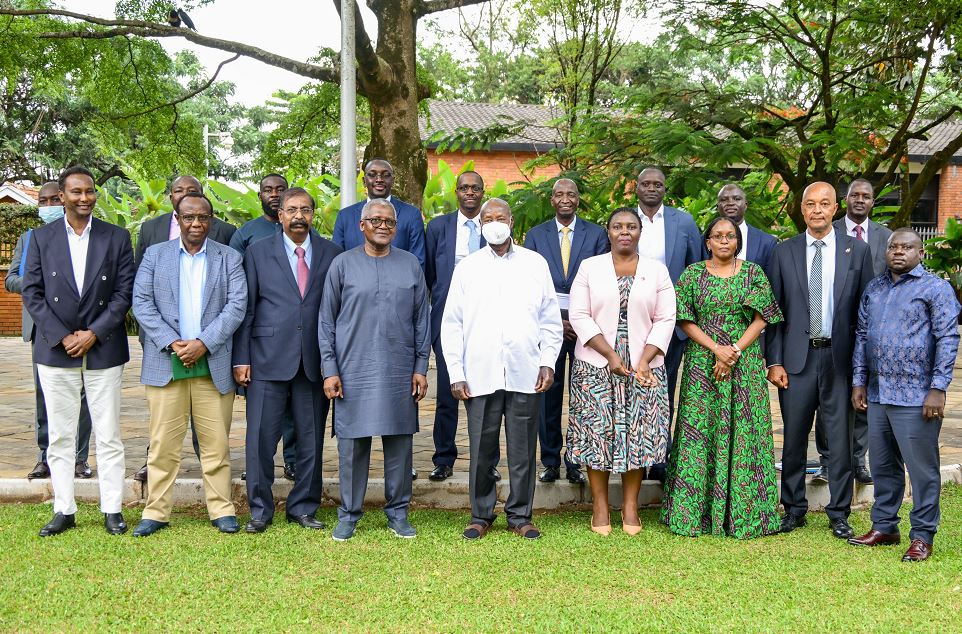
President Yoweri Kaguta Museveni has held talks with Nigerian billionaire industrialist Aliko Dangote in Kampala over a proposed East African regional oil refinery project aimed at boosting value addition, regional integration, and energy security across the region.
The meeting took place at State House Nakasero and was later confirmed by President Museveni through a statement shared on his official social media platforms.
According to Museveni, discussions focused on the development of a larger regional refinery that would serve East African markets while complementing Uganda’s ongoing domestic refinery plans in Hoima District.
“Today at Nakasero, I met Mr. Aliko Dangote and we discussed the proposed East African regional refinery,” Museveni stated.
The Ugandan leader said his government has consistently opposed the export of crude oil without local processing, emphasizing that Uganda deliberately delayed oil production to prioritize refinery development and industrialization.
“From the very beginning, we have always opposed the export of raw materials without value addition,” Museveni said.
“Without refining our oil, it would not make economic or strategic sense to simply export crude oil while others benefit from the finished products.”
Uganda has pursued plans for a domestic oil refinery for more than a decade as part of efforts to maximize economic returns from its estimated 6.5 billion barrels of crude oil reserves discovered in the Albertine Graben region.
The proposed Uganda refinery in Hoima is expected to process crude oil from the Tilenga and Kingfisher oil fields being developed by TotalEnergies, CNOOC, and the Uganda National Oil Company (UNOC).
Government officials have repeatedly argued that refining crude oil locally would help reduce fuel import dependence, create jobs, support industrial growth, and stabilize energy supplies.
Aliko Dangote, Africa’s richest businessman and founder of the Dangote Group, is widely recognized for developing the Dangote Petroleum Refinery in Lagos, Nigeria currently Africa’s largest refinery project.
The refinery, which began operations recently, was designed to significantly reduce Nigeria’s dependence on imported refined petroleum products and strengthen regional fuel supply chains.
Dangote’s meeting with Museveni has therefore attracted attention across the energy sector, with analysts viewing it as a sign of potential regional cooperation on refining infrastructure and downstream petroleum investment.
However, neither Museveni nor Dangote publicly announced any signed agreement, investment figures, or implementation timeline following the meeting.
Museveni said Uganda supports the idea of a broader East African refinery initiative as part of efforts to strengthen African economic integration and shared prosperity.
“We cannot continue operating as fragmented and weak markets,” Museveni stated.
“If East Africa works together, such projects become more viable and beneficial to our people.”
The East African Community (EAC), which includes Uganda, Kenya, Tanzania, Rwanda, Burundi, South Sudan, the Democratic Republic of Congo, and Somalia, has increasingly promoted regional infrastructure cooperation in energy, transport, and trade.
Energy experts say regional refinery projects could potentially lower transportation costs, improve fuel availability, and strengthen strategic energy reserves across East Africa.
Despite supporting the regional proposal, Museveni emphasized that Uganda remains committed to developing its own refinery in Hoima.
“Uganda is ready to support the regional refinery initiative while also continuing with the development of our own refinery in Hoima,” he said.
Construction and financing discussions surrounding the Hoima refinery project have faced delays over the years, though Ugandan authorities continue to describe it as a key pillar of the country’s long-term industrialization strategy.
While the meeting signals growing regional interest in petroleum processing and value addition, further details regarding the proposed East African refinery remain limited.
Industry observers expect additional consultations between governments, investors, and energy stakeholders before any formal regional refinery framework is finalized.
The discussions come at a time when African governments are increasingly seeking to expand local refining capacity to reduce fuel import costs and strengthen economic self-reliance.