Agriculture
A decade after a ravaging famine, a village fights the reoccurrence of such a disaster

By Edgar Tushabe Muhairwe
Kabuga Village, in Kabuga Parish, Kihiihi Town Council has had a fair share of the menace that climate change has become around Kigezi region. The village of close to 200 families has relied heavily on subsistence agriculture for generations, but is lately fighting food insecurity.
Peter Muhumuza, a small landowner is a member of the Kabuga Village Smallholder Farmers Association (KASFA). Speaking to Margherita News, Peter intimates that the village had for a number of seasons realised losses in harvests, until they came together to find solutions.
“As you know, Kigezi has always been a food basket of the country, and even the region. But since about 2015-16 seasons, we have been experiencing unusually heavy rains and unusually long droughts. This is unlike what we have been used to.”
The Daily Monitor newspaper reported in 2017 of five deaths in Kanungu caused by famine. The staple food of the people of Kigezi, like millet and Irish potatoes had been devastated because of intermittent periods of long droughts and rains. Dr Aloysius Tumwesigye the District Production Officer speaking to Daily Monitor then, told the country that for two seasons, the district registered 60% crop failure because of little rain.
“This was a huge setback to a community that had always been a food basket, even with their small pieces of land. Practices like terracing on hillsides could no longer sustain the erosion of soil, and the depletion of nutrients. The numbers of people have also increased tremendously causing land degradation.” Brian Atuheire, the Executive Director African Initiative on Food Security and Environment (AIFE). AIFE is a nonprofit organisation established to fight against climate change and teach farmers climate-smart practices to fight food insecurity.

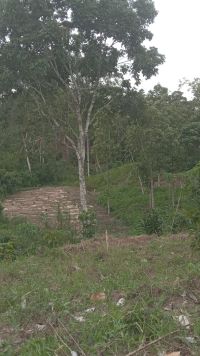
An amateur shot of mahogany farm with beans and groundnuts
“We started a field office in Kihiihi Town Council to assist the people on their resilient journey to reestablish their farms to productivity.”
In late 2021, the KASFA was formed. “A group of families came together to share to share best practices, and their farms for the benefit of the community.” Says Grace Nsimire, a field officer with AIFE.
The association entered hitherto unknown projects like fish farming, agroforestry and smart methods of mixed cropping.
“We agreed that famine should never kill the people again. So, we introduced classes in agroecology in July 2022. The participants have been very cooperative and we can see results.”
Peter owns a 5-acre piece of land that has had mahogany trees for generations. When the association was established, he agreed to share it with other two families on the village who stay close to the town and have negligible plots for farming. This season, they have grown beans and groundnuts on Peter’s land. This has built a more resilient community that has depended on each other for benefits beyond subsistence to include social cohesion and commercial benefits.
“When you look at this particular case of sharing land resources and mixed cropping of beans, groundnuts and natural trees like the mahogany, you will notice that the three crops assist each other against sunshine and improve soil fertility.” Grace says.
“The legumes improve the fixation of nitrogen in the soil. But also, the groundnuts cover the soil and act as mulches, thus preventing soil erosion. The beans, beyond nitrogen fixation also help protect the groundnuts as a canopy against direct sunlight, yet they also benefit from the mahogany for the same. A whole ecological cycle is sustained alongside food security.” Grace explains further.
On the same village, about a kilometre away, Grace leads Margherita News to Geoffrey Batenda’s farm. Geoffrey was not affected by the 2017 famine personally, however, at 82 years, he says that he has witnessed the changing food fortunes of his region for generations, “and the future of food security is bleak.”


One of the fish ponds in the aquaculture project
Geoffrey has also given a section of his farmland to a section of members of the KASFA association to use for their food security projects. As a land owner, he is automatically a member and beneficiary.
The group of women has partnered to do fish farming, grow matooke, yams, coffee and upland rice. This project is centred around fish farming, with the group owning 5 ponds of tilapia and catfish. Aquaculture is a good agroecology initiative because it has vast benefits in terms of nutrition, maximizing land use, while sustaining a healthy eco system.
Tadeo Twinomujuni, the Kabuga Local Council 1(LCI) chairman says that he is pleased with the visible betterment of child health on the village. “There was visible stuntedness on the village. Children were falling sick easily and families could not afford good medical care in town.”
Although the group’s financial estimates are not exact, estimates from the Ministry of Agriculture, Animal Husbandry and Fisheries (MAAIF) are that a pond can produce 750kg of fish per year, per pond. A kilogram of fish on the market is about Ugx.11,000. This makes it about 8,250,000 million per pond in a year.
The growing of rice and matooke around the fish farm also improves the efficient use of water and regulation of temperatures that could interfere with productive aquaculture. The group keeps catfish and tilapia which are indigenous and feed on locally available food, insects and plant materials like algae in the ecosystem of the pond. The two fish species are also resilient to temperature and oxygen fluctuations.
This aquaculture project has inadvertently enabled community protection of surrounding wetlands and water streams across the village and beyond.
Tadeo is pleased with the agroeconomic initiatives on his village and is upbeat that the days of famine will not return in Kabuga. “For the about 3 years now since these initiatives started, we have not seen anything severe compared what happened almost ten years ago. The economic life of the village and food security has drastically changed for the better.”