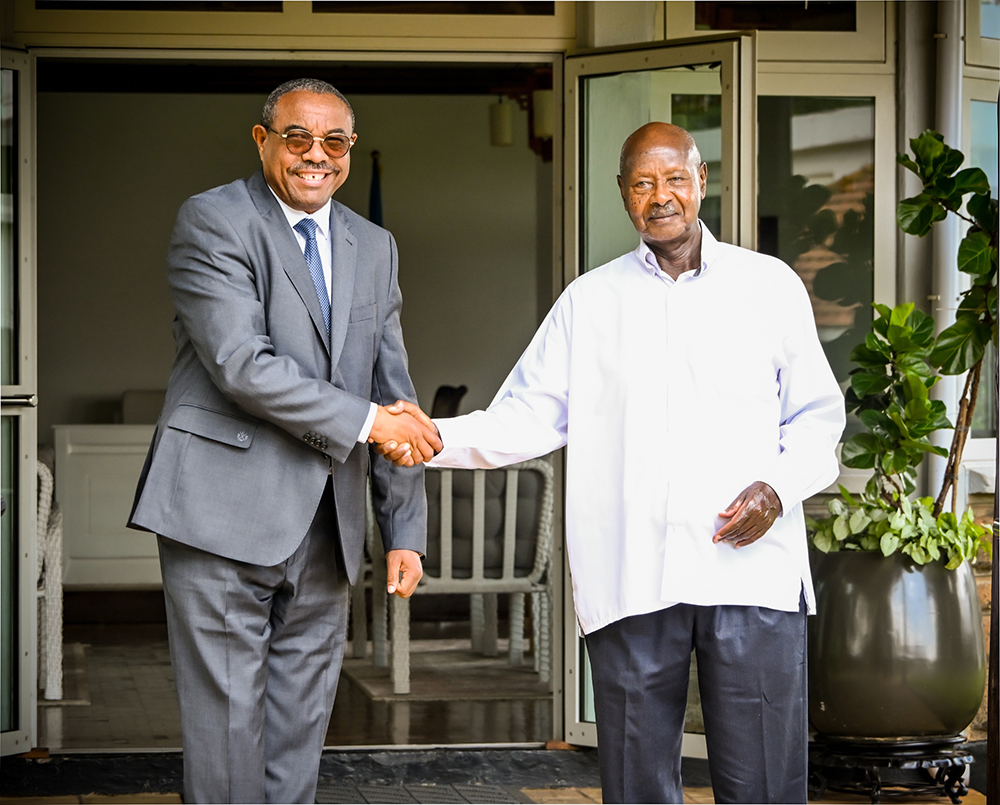
Uganda is intensifying efforts to transform its agricultural sector, with President Yoweri Museveni highlighting new partnerships aimed at improving productivity, strengthening livestock systems, and expanding food security.
In a statement shared on X, Museveni said he hosted former Ethiopian Prime Minister Hailemariam Desalegn at Nakasero State Lodge, alongside representatives from the Alliance for a Green Revolution in Africa. The discussions focused on agricultural research, irrigation systems, improved seed varieties, fertiliser use, and the strengthening of local seed systems to boost both food security and rural incomes.
Museveni also raised concerns about livestock husbandry, noting historical challenges where cattle moved long distances in search of pasture and water, increasing vulnerability to disease outbreaks. He called for greater investment in animal feed research to support modernised livestock production systems.
The meeting reflects Uganda’s broader push to transition from subsistence farming toward commercially driven agriculture anchored in science, inputs, and value-chain development.
At a separate engagement in Nairobi at the Africa Finance Summit, Museveni reiterated Uganda’s growing investment in agricultural innovation, announcing progress on locally developed vaccines, including an upcoming launch of an anti-tick vaccine. He framed such developments as part of a wider strategy to reduce dependency on imports and strengthen domestic agricultural resilience.
Since stepping down as Ethiopia’s Prime Minister in 2018, Desalegn has repositioned himself as a leading advocate for agricultural transformation in Africa. As Board Chair of AGRA, he has focused on scaling sustainable farming systems, improving access to inputs, and supporting smallholder farmers across the continent.
Climate variability, land degradation, and limited access to modern inputs continue to constrain productivity for millions of smallholder farmers. In parts of Uganda, erratic rainfall patterns and rising input costs have further strained rural livelihoods, increasing the urgency of structural reforms in the sector.
Across Africa, food security remains a central development challenge despite the continent’s vast agricultural potential. The continent holds a significant share of the world’s arable land, yet productivity remains comparatively low due to limited mechanisation, underdeveloped irrigation infrastructure, and fragmented seed systems. These structural gaps have left many countries reliant on food imports or vulnerable to global price shocks.
Regional leaders have increasingly framed agricultural transformation as a strategic priority for economic stability. Investments in improved seeds, fertilisers, irrigation, and livestock disease control are being positioned not only as development interventions but as foundational pillars for economic sovereignty and resilience.