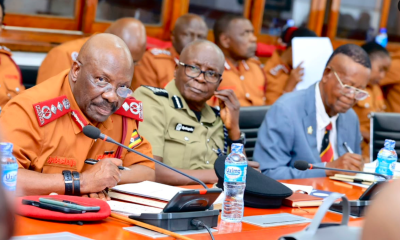
Deputy Speaker of Parliament Thomas Tayebwa has challenged young leaders to use their voices and ideas to influence national development warning that meaningful democracy depends on the quality of ideas brought into public debate rather than the volume of political voices.
Tayebwa made the remarks on Friday while opening the second sitting of the 8th National Youth Parliament in the chambers of the Parliament of Uganda.
Tayebwa urged youth leaders participating in the parliamentary session to treat the platform as an opportunity to sharpen their views, debate national challenges and develop proposals that can contribute to the country’s development.
“Parliament is not strengthened by the loudest voices but by the strongest ideas,” Tayebwa said.
He told the young leaders that their responsibility extends beyond speaking for themselves urging them to represent the concerns of millions of young Ugandans facing challenges in employment, entrepreneurship, agriculture and equal access to opportunities.
“Never underestimate the responsibility you carry,” Tayebwa said, urging participants to speak for young entrepreneurs struggling to build businesses, graduates seeking employment, farmers seeking better opportunities and young women seeking equal opportunities.
Tayebwa also reaffirmed Parliament’s commitment to ensuring that resolutions adopted during the Youth Parliament are not left as discussions within the youth forum.
He said the resolutions will formally be received by the Office of the Clerk to Parliament and transmitted to the Uganda Parliamentary Forum on Youth Affairs.
Where appropriate, the resolutions will also be referred to relevant government institutions for consideration.
The commitment gives the Youth Parliament a potential pathway for translating youth concerns into policy discussions within the mainstream parliamentary and government structures.
The National Youth Parliament has increasingly provided young people with an opportunity to debate issues affecting their lives and interact with policymakers. The initiative has been convened annually around International Youth Day, creating a space for young representatives to discuss national priorities and formulate policy recommendations.
Tayebwa’s call comes as the country begins a new parliamentary term and faces the challenge of translating its youthful population into an economic and democratic advantage.
The 12th Parliament, which began in May 2026 and runs until May 2031, currently has 549 members, including five representatives specifically elected to represent the youth.
Beyond the five youth representatives in Parliament, young people form a much larger section of the population and are central to the country’s future workforce, political leadership and economic transformation.
This demographic reality places employment, skills development, entrepreneurship and meaningful political participation high on Uganda’s development agenda.
The UNDP has described the country’s youthful population as both an opportunity and a challenge, arguing that young people can drive innovation and economic transformation if they have access to relevant skills and supportive systems.
For many of the young people Tayebwa urged participants to represent the most immediate concern is finding decent work or establishing sustainable businesses.
The pressure on the labour market has increased the importance of entrepreneurship, digital skills, vocational training and access to finance.
Recent UNDP programmes in Uganda have focused on equipping young people with skills in areas ranging from digital technology and artificial intelligence to entrepreneurship, green jobs and vocational training. Its 2025 youth-skilling portfolio, published in February 2026, highlights the need to connect young people to skills, jobs and employment opportunities as the economy changes.
The organisation has also supported initiatives aimed at developing digital skills among young Ugandans. In one programme, 144 young people graduated after training in areas including data science, artificial intelligence, cybersecurity, software development, product design and cloud computing.
UNDP has noted that micro, small and medium enterprises account for more than 90 percent of Uganda’s private sector and provide the majority of jobs, particularly for youth and women.
Tayebwa specifically highlighted young women and farmers in his message to the Youth Parliament, reflecting some of the broader challenges facing young people outside formal employment.
Young women continue to face barriers to economic participation, while young people engaged in agriculture often struggle with access to finance, markets, technology and value-addition opportunities.
Uganda’s development partners have increasingly promoted entrepreneurship and innovation as ways of addressing these gaps.
For example, UNDP’s Youth4Business programme has supported youth-led businesses in agriculture, tourism, manufacturing, renewable energy, information technology and the creative industries.
The organisation has also supported innovation hubs and business incubation programmes designed to help young entrepreneurs turn ideas into commercially viable enterprises.
These efforts underline the importance of Tayebwa’s call for young leaders to bring practical ideas to national discussions rather than simply highlighting problems.
The 2026 International Youth Day theme, “Different Contexts, Common Aspirations,”recognises that young people live in different social, economic and geographic circumstances but often share similar ambitions.
These include access to quality education, decent employment, meaningful participation in decision-making, good health and opportunities to build a better future.
The theme is particularly relevant to Uganda, where young people in urban areas may face different challenges from those in rural communities, yet both groups are affected by issues such as unemployment, limited economic opportunities and skills gaps.
The United Nations has described International Youth Day observed annually on August 12 as an opportunity to raise awareness of challenges facing young people while recognising their contribution to development.
The key question now is whether resolutions from the Youth Parliament will move beyond the chambers and influence government policy.
Tayebwa’s commitment that the resolutions will be formally received and forwarded to relevant institutions provides a mechanism through which youth proposals can enter the wider policymaking process.
However, the effectiveness of the initiative will depend on what happens after the sitting: whether resolutions are followed up, considered by government institutions and translated into policies, programmes or budget priorities.
For the young participants, the responsibility is equally significant.
Tayebwa’s message was that youth participation in democracy should not be measured simply by the opportunity to speak but by the ability to develop well-researched ideas and advocate for practical solutions.