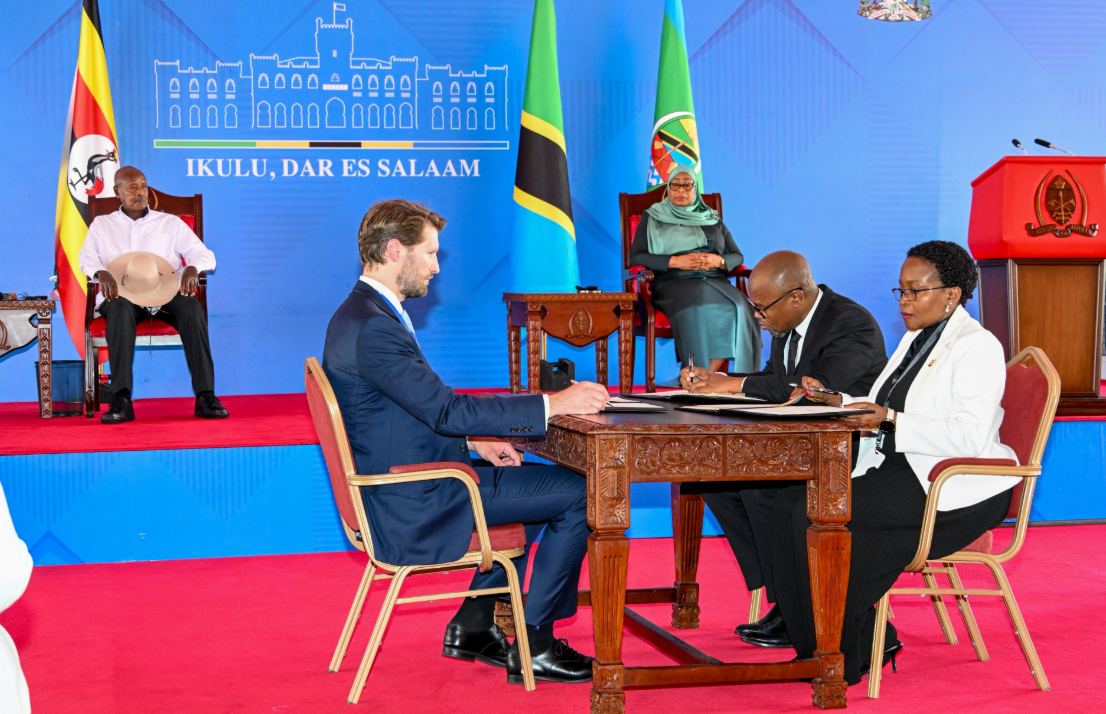
Uganda and Tanzania have signed a memorandum of understanding with energy trader Vitol to develop a regional energy hub at the Tanzanian port of Tanga in the latest step towards deeper cooperation between the two neighbours.
Ugandan President Yoweri Museveni and Tanzanian President Samia Suluhu Hassan witnessed the signing in Dar es Salaam.
The agreement brings together the Uganda National Oil Company (UNOC), Tanzania Petroleum Development Corporation (TPDC) and Vitol Bahrain E.C.
Uganda says the planned Tanga Regional Energy Hub is intended to strengthen energy security, trade and industrialisation in East Africa.
President Museveni said the project would build on the countries’ cooperation around the East African Crude Oil Pipeline (EACOP) and help the region extract more value from its petroleum resources.
Uganda is developing an oil industry around its discoveries in the Lake Albert region, with the government seeking to move beyond simply exporting crude.
Under the latest arrangement, the Tanga hub is expected to support activities including refining, petroleum storage, logistics and manufacturing.
President Museveni said the combination of the Tanga hub and the planned refinery in Hoima would allow the region to capture more value from its petroleum resources rather than exporting raw materials.
The approach reflects a broader push by Uganda and other East African countries to develop infrastructure that can support domestic and regional petroleum markets.
This agreement is closely connected to EACOP, the massive pipeline project linking Uganda’s oilfields to the Tanzanian coast.
The pipeline stretches about 1,443km from Kabaale in Hoima District to the Chongoleani Peninsula near Tanga. Uganda accounts for about 296km of the route.
The pipeline is designed to transport crude produced from Uganda’s Lake Albert oilfields to Tanga, where it can be transferred for export to international markets.
Tanga has therefore become strategically important to Uganda’s oil plans.
The latest agreement suggests the two countries are seeking to expand that relationship beyond the transportation of crude.
For Tanzania, Tanga’s location on the Indian Ocean gives it an important role in regional energy logistics.
Uganda is landlocked and depends on neighbouring countries and transport corridors to move petroleum products and other goods to international markets.
The relationship between the two countries has consequently expanded beyond oil.
In February, Presidents Museveni and Samia said they wanted to strengthen cooperation in energy, trade, infrastructure and regional peace.
At the time, Tanzania said it was also exploring additional energy links with Uganda, including a gas pipeline and a refined petroleum products pipeline towards Tanga.
The Tanga project comes as the country continues with plans for a refinery at the Kabaale Industrial Park in Hoima.
The proposed refinery is intended to process crude oil domestically, helping Uganda reduce its dependence on imported refined petroleum products.
Government has repeatedly argued that domestic refining would allow more of the economic benefits from oil to remain within Uganda.
Museveni has similarly promoted regional cooperation as a way of ensuring that African countries process their own natural resources rather than exporting them in raw form.
The idea is particularly relevant for East Africa, where countries remain heavily dependent on imported petroleum products.
Tanga hub is also part of a wider debate about how East Africa can improve its energy security.
Countries in the region have historically relied heavily on imported fuel, leaving them exposed to international oil prices, shipping disruptions and geopolitical shocks.
A regional network of storage, transportation, refining and manufacturing facilities could reduce some of those vulnerabilities.
Earlier this year, East African leaders also discussed the possibility of a regional refinery at Tanga, with Kenya’s President William Ruto saying countries including Uganda, Tanzania, Kenya, South Sudan and the Democratic Republic of Congo were considering the idea.
That proposal is separate from the newly announced MoU but it demonstrates the growing strategic importance of Tanga in East Africa’s energy plans.
The involvement of Vitol, one of the world’s largest independent energy and commodities trading companies, adds an international commercial dimension to the partnership.
Vitol trades and transports energy products globally and has extensive experience in petroleum supply chains.
Its participation could potentially provide expertise in areas such as petroleum logistics, trading and supply.
However, the full financial structure, investment commitments, construction schedule and precise capacity of the proposed Tanga hub have not yet been publicly detailed.
Those details are likely to determine how quickly the agreement moves from an MoU into a functioning regional facility.
Uganda sees the project as an opportunity to build a wider petroleum value chain.
Instead of stopping at crude production and export, the government wants to develop industries around refining, storage, transport and manufacturing.
That could potentially create jobs, increase tax revenues and reduce the country’s exposure to imported petroleum products.
It could also strengthen Uganda’s position in regional energy trade.
But those benefits will depend on whether the planned infrastructure is financed and delivered efficiently and whether the resulting petroleum products can compete with imports.
An MoU is generally a framework for cooperation rather than a guarantee that a project will immediately be built.
The next stage will be to establish the project’s technical and commercial details, including financing, ownership, infrastructure requirements, environmental approvals and an implementation timetable.