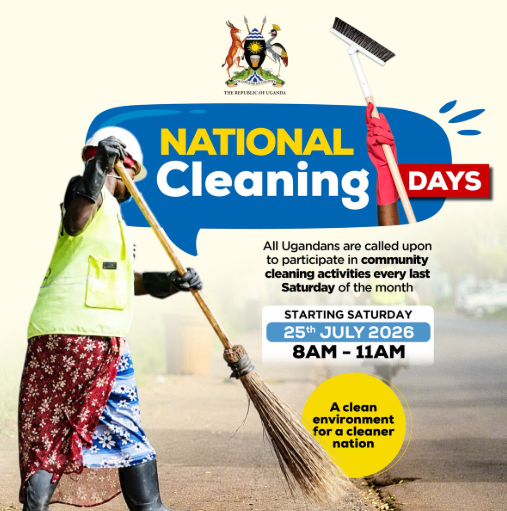
Uganda has introduced a mandatory monthly National Cleaning Day, requiring citizens across the country to participate in organised community clean-up activities as part of a nationwide campaign to improve sanitation, reduce disease outbreaks and protect the environment.
The exercise, which will take place every last Saturday of the month from 7:00am to 10:00am where non-essential movement are suspended, businesses temporarily closed and only emergency, security and other authorised vehicles permitted on the roads.
Prime Minister Robinah Nabbanja announced the directive at the Office of the Prime Minister in Kampala alongside officials from the Ministry of Health, Ministry of Local Government, Kampala Capital City Authority (KCCA), the Uganda Police Force and the National Environment Management Authority (NEMA).
The first nationwide exercise is scheduled for Saturday, 25 July 2026, with the official launch taking place in Kisenyi, Kampala, where Vice-President Jessica Alupo is expected to lead the inaugural clean-up campaign.
Government says the initiative is intended to tackle poor sanitation, which officials describe as one of the country’s leading public health concerns.
Speaking during the launch, Nabbanja said approximately 75% of diseases reported in Uganda are linked to poor hygiene and sanitation, citing malaria, diarrhoea and typhoid among the illnesses that continue to place pressure on the country’s healthcare system.
She also referenced Ministry of Health data indicating that around 33 children die every day from diseases associated with poor sanitation and inadequate hygiene, underscoring the need for stronger community involvement in maintaining clean environments.
Officials argue that many of these illnesses are preventable through proper waste management, improved drainage and better environmental hygiene.
Government officials used Kampala’s waste management challenges to illustrate the scale of the problem.
According to Nabbanja, the capital generates between 2,000 and 2,500 tonnes of solid waste every day, yet only 50% to 60% is collected and properly disposed of.
The remaining waste often accumulates in drainage channels, road reserves and public spaces, contributing to flooding during heavy rains, creating breeding grounds for mosquitoes and increasing the risk of cholera, typhoid and other waterborne diseases.
Urban planners have repeatedly warned that Kampala’s rapid population growth has outpaced waste collection infrastructure, leaving city authorities struggling to manage increasing volumes of garbage.
National Cleaning Day programme is rooted in a Cabinet resolution adopted on 11 August 2025, during a meeting chaired by President Yoweri Museveni, which approved the establishment of a nationwide public cleaning initiative.
Its implementation was later formalised throughCabinet Circular No. 1 of 2026, directing ministries, local governments and public institutions to organise monthly community clean-up exercises beginning in July 2026.
Nabbanja said the programme is also anchored in Article 39 of Uganda’s Constitution, which guarantees every citizen the right to a clean and healthy environment while imposing a responsibility to protect and preserve it.
Government officials say the initiative is therefore intended not only as a public health intervention but also as the fulfilment of a constitutional obligation shared by both the state and citizens.
During the three-hour exercise, communities across Uganda will be expected to participate in organised cleaning activities coordinated by local authorities.
Local governments have been instructed to mobilise residents, identify sanitation hotspots and supervise the activities within their jurisdictions.
Implementation guidelines are expected to be issued following the official launch of the programme.
One of the most significant aspects of the initiative is the temporary restriction on public movement.
Between7:00am and 10:00am, businesses will remain closed while unnecessary movement of people and private vehicles will not be permitted.
Only emergency services, security agencies and other authorised vehicles will be allowed to operate during the exercise.
Government officials say the temporary restrictions are intended to ensure widespread participation rather than allowing residents to continue with normal commercial activities.
The directive has prompted debate among sections of the business community over its potential economic impact, although officials argue that a three-hour monthly suspension represents a reasonable compromise for long-term public health benefits.
Deputy Inspector General of Police James Ochaya said the Uganda Police Force is prepared to enforce compliance with the directive.
He noted that police would rely on experience gained during enforcement of public health measures introduced during the Covid-19 pandemic.
Authorities are expected to deploy officers across the country to monitor movement, regulate traffic and ensure residents participate in community cleaning exercises.
The announcement has generated questions from members of the Seventh-day Adventist (SDA) Church, whose principal day of worship falls on Saturday.
Responding to those concerns, Health Minister Dr Chris Baryomunsi said the programme had deliberately been scheduled during the early morning hours to minimise interference with religious services.
He said the initiative was not intended to target or discriminate against any religious community but rather to encourage all Ugandans to contribute to protecting public health.
Quoting biblical teachings, Baryomunsi argued that preserving life and preventing disease were responsibilities shared by all citizens regardless of religious affiliation.
His remarks have generated discussion among religious leaders, some of whom have welcomed further engagement with government regarding implementation.
Uganda’s National Cleaning Day bears similarities to Rwanda’s Umuganda, a monthly community service programme held on the last Saturday of each month.
Introduced after the 1994 genocide, Umuganda requires citizens to participate in public works ranging from environmental cleaning to road construction and community development projects.
The programme has been widely credited with improving sanitation, strengthening community participation and contributing to Rwanda’s reputation as one of Africa’s cleanest countries.
Ugandan officials have not explicitly stated that the new initiative is modelled on Rwanda’s experience, but public health experts note that both programmes rely heavily on community participation rather than government-led waste collection alone.
Environmental health specialists say poor sanitation remains a major contributor to preventable illness across Uganda.
Blocked drainage channels increase mosquito breeding, contributing to malaria transmission, while unmanaged waste contaminates water sources and facilitates outbreaks of diarrhoeal diseases.
According to the World Health Organization (WHO), improving sanitation and hygiene is among the most cost-effective public health interventions available, significantly reducing the incidence of waterborne diseases and lowering healthcare costs.
Supporters argue that cleaner communities will improve public health, reduce flooding and encourage greater civic responsibility.
Others have questioned whether restricting movement and closing businesses every month could affect livelihoods, particularly for informal traders who depend on daily income.
Government officials maintain that implementation guidelines will address these concerns before the programme is rolled out nationwide.
Uganda’s first mandatory National Cleaning Day will take place on Saturday, 25 July 2026, from 7:00am to 10:00am, after which the exercise will become a recurring event on the last Saturday of every month.
Held under the theme“A Clean Uganda is Everybody’s Business,” the initiative represents one of the country’s most ambitious community-based public health campaigns in recent years.