Speaker of Parliament Jacob Oboth Oboth has held talks with Archbishop Kaziimba Mugaluon strengthening cooperation between the government and the Church to improve household welfare and promote community development.
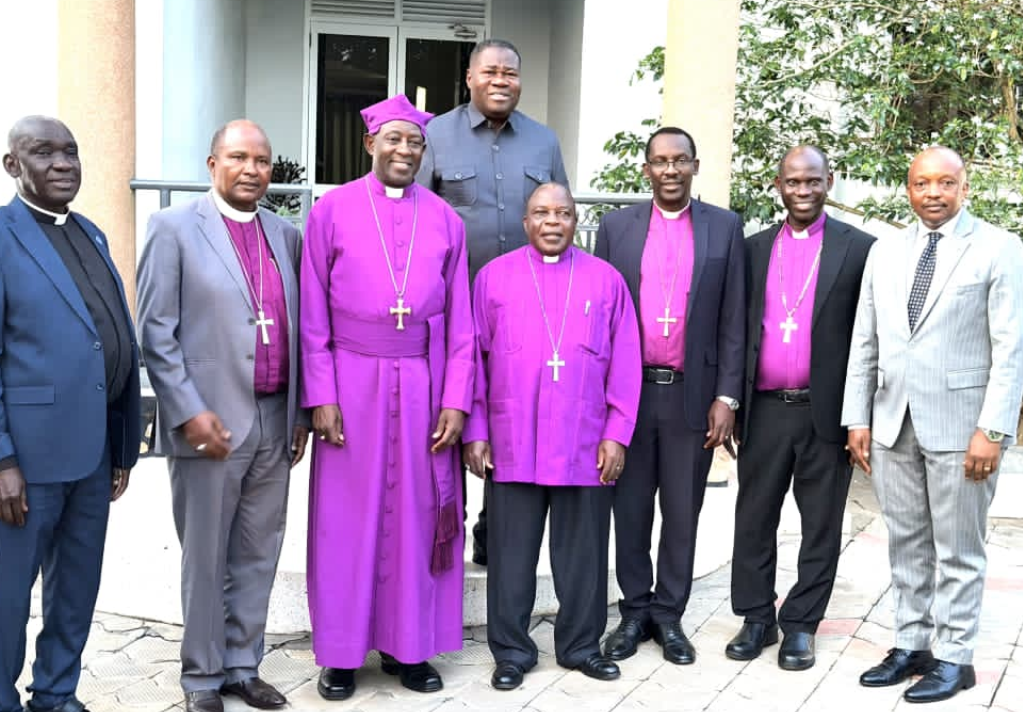
Oboth hosted a delegation from the Church of Uganda at his home in Mukono on Thursday evening with the discussions led by Archbishop Kaziimba Mugalu.
According to our reporter, the meeting focused on areas where the Church and government can work together to advance household transformation and the wellbeing of communities across Uganda.
The engagement comes as Oboth begins his tenure as Speaker of the 12th Parliament having been elected to the position on May 25, 2026, with 441 votes. He succeeded Anita Annet Among and now chairs Parliament and the Parliamentary Commission.
During the meeting, the Church of Uganda delegation congratulated Oboth on his election and prayed for wisdom, strength and guidance as he assumes responsibility for leading the legislative arm of government.
The delegation was headed by Archbishop Kaziimba and included senior Church leaders from several dioceses that included Rt Rev. Fred Sheldon Mwesigwa, Bishop of Ankole Diocese; Rt Rev. Grace Lubaale, Bishop of Busoga Diocese; Rt Rev. Samuel Bogere Egesa, Bishop of Bukedi Diocese; and Rt Rev. Enos Kitto Kagodo, Bishop of Mukono Diocese.
Also, present were Canon Naboth Muhairwe, Provincial Chancellor, and Rev. Canon William Ongeng, Provincial Secretary.
The visit places the relationship between political institutions and religious organisations in focus particularly in areas where government programmes intersect with community-based initiatives.
The discussions around household transformation have particular significance because the Church of Uganda has an established development structure dedicated to improving livelihoods.
The Church’s Directorate of Household and Community Transformation, formerly known as Planning and Development and Rehabilitation describes itself as the social and economic development arm of the Church.
Its stated goal is to improve the livelihoods of households and communities across Uganda and help communities become more self-reliant.
The directorate works in areas including food security and sustainable livelihoods, income security, environmental and climate action, disaster preparedness, water and sanitation, gender justice and youth skilling.
This makes the Church an important potential partner in efforts aimed at translating national development priorities into interventions at household and community level.
Its approach emphasises participation by local communities, leaders, volunteers and beneficiaries, with the objective of enabling communities to identify their own challenges and take action towards addressing them.
The discussions between the Speaker and Church leaders could therefore provide an opportunity for greater coordination between parliamentary priorities, government programmes and community-level interventions.
Religious institutions have an extensive presence in communities across Uganda and are involved in education, healthcare, livelihoods, social services and advocacy.
For Parliament, closer engagement with such institutions could also provide legislators with a better understanding of challenges affecting households outside the national political centre.
However, cooperation between government and religious institutions also requires clear roles and accountability, particularly where public resources or government programmes are involved.
The Church’s own development strategy stresses community ownership and participation, which could complement government efforts aimed at improving household incomes and living standards.
The meeting comes less than three months after Oboth was elected Speaker of the 12th Parliament.
He defeated Opposition-backed candidate Paul Mwiru, who received 60 votes, while Norbert Mao obtained 15 votes. Oboth secured 441 votes.
In his first address to Parliament, Oboth pledged to promote fairness, equity and evidence-based legislation, while urging MPs to remain available to the people they represent. He also said Parliament should work towards becoming a more people-centred legislature.
As Speaker, Oboth is responsible for presiding over parliamentary sittings and ensuring that debates are conducted in accordance with the Rules of Procedure. He also chairs the Parliamentary Commission, the Committee on Appointments and the Business Committee.
His engagement with the Church of Uganda therefore comes at the beginning of a new parliamentary term in which issues such as household incomes, service delivery, employment, agriculture and community development are expected to remain central to national debate.