KAMPALA, Uganda – President Yoweri Kaguta Museveni has paid tribute to the late Gen. (Rtd) Moses Ali, describing him as a patriot, freedom fighter and peacemaker whose contribution to Uganda’s political history and the development of the West Nile region will not be forgotten.
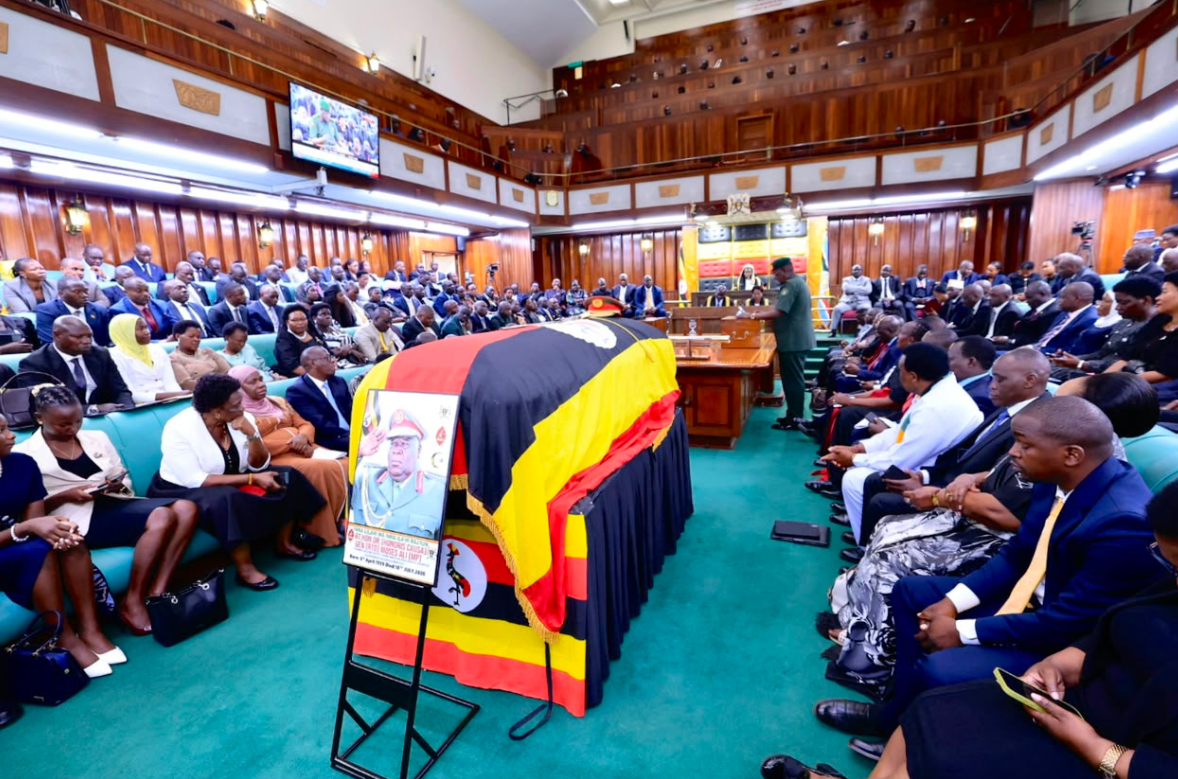
Members of Parliament, government officials, family members and friends gathered at Parliament to pay their final respects, with senior leaders including Vice President Jessica Alupo, Speaker Jacob Oboth Oboth, Deputy Speaker Thomas Tayebwa and Prime Minister Robinah Nabbanja joining in the tributes.
In his tribute, President Museveni said Gen. Moses Ali’s public life was defined by three major qualities: his commitment to freedom, his role as a peacemaker and his dedication to development.
“I was able to hear and see three elements of his contribution to Uganda. He was a lover of freedom, peacemaker and a development person,” Museveni said.
The President said Ali’s contribution extended beyond military and political leadership, highlighting his efforts to promote peace and economic progress, especially in the West Nile sub-region.
Reflecting on Uganda’s turbulent political history, Museveni spoke about Gen. Moses Ali’s role during the government of former President Idi Amin, who came to power after a military coup in 1971.
Although Ali served in Amin’s government, Museveni said the late general became increasingly uncomfortable with the brutality and excesses of the regime.
“I heard that Moses Ali was not happy with Idi Amin’s power. I heard that Moses Ali was not happy with Idi Amin killing people,” Museveni said.
According to Museveni, Ali’s disagreement with Amin’s leadership eventually affected his position within government.
“I think by the time we captured Kampala, I don’t think he was in the government… I heard that he was like suspended or something,” he added.
Museveni said these events showed that Ali valued justice and freedom above political positions.
President Museveni recalled meeting Moses Ali personally inLibya in 1981, when different Ugandan liberation groups had gathered following an invitation from former Libyan leader Muammar Gaddafi.
At the time, Gaddafi encouraged the groups to unite under one organisation. However, Museveni said the movements agreed instead to coordinate their efforts while maintaining separate identities until they could reach a common political understanding.
According to Museveni, Moses Ali stood out as a leader who promoted cooperation rather than conflict.
He said that relationship later became important during the final stages of the struggle that led to the National Resistance Army (NRA) capturing Kampala in 1986.
Museveni said Moses Ali and Uganda National Rescue Front (UNRF) gradually withdrew from confrontation with the NRA, helping prevent further bloodshed.
“I agreed with Moses Ali that the UNRF people pulled out slowly. And he pulled out slowly. They didn’t fight us when we were entering Kampala. That’s how our cooperation started,” Museveni said.
Beyond politics and military history, Museveni highlighted Gen. Moses Ali’s contribution to the development of the West Nile region.
The President said Ali consistently advocated for improved infrastructure, electricity, support for veterans and increased government investment in the region.
“The tarmac road, electricity, the issue of the veterans, he was always on the forefront. And many of his pressures on us have already brought results,” Museveni said.
He described Ali as a leader who consistently pushed for better economic opportunities and improved living conditions for people in West Nile.
Gen. Moses Ali had one of the longest public service careers in Uganda, serving in both military and civilian leadership roles for nearly six decades.
Born on 5 April 1939 in Meliaderi village, present-day Adjumani District, Ali joined the Uganda Army in the 1960s and rose through the ranks before becoming a key figure in Uganda’s political and military history.
He later served in several government positions, including First Deputy Prime Minister, Deputy Leader of Government Business in Parliament, and held multiple ministerial portfolios.
As the long-serving Member of Parliament for Adjumani West County, Ali became known as an experienced legislator and a strong voice for peace and development in West Nile.
During the parliamentary special sitting, Speaker Jacob Oboth Oboth received the casket containing Gen. Moses Ali’s remains as lawmakers and national leaders honoured his service.
The late general’s family, colleagues and political leaders described him as a figure whose life reflected Uganda’s complex journey through periods of conflict, reconciliation and nation-building.
As Uganda remembers Gen. Moses Ali, President Museveni said his legacy would remain tied to peace-building, national service and regional development.
From soldier to politician, rebel leader to government minister, Ali’s career reflected many chapters of Uganda’s modern history.
His supporters and colleagues say his contribution to peace and development, particularly in West Nile, will continue to shape the country’s political landscape for generations.