Environment
Uganda Police to Restrict Nationwide Traffic for National Cleaning Day
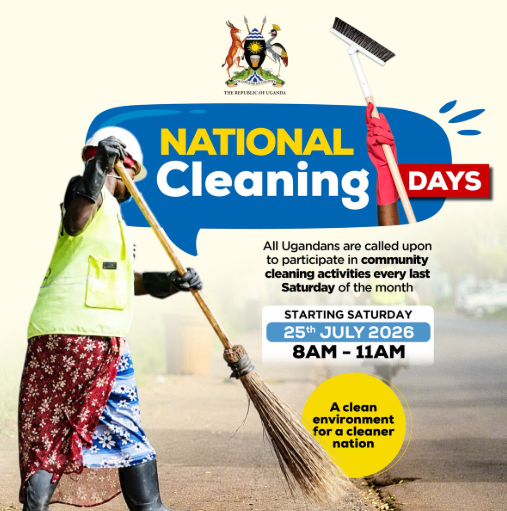
Uganda Police have announced nationwide traffic restrictions for Saturday, 25 July, as the country prepares to observe its first mandatory National Cleaning Day, a government initiative aimed at improving sanitation, reducing disease outbreaks and promoting environmental responsibility.
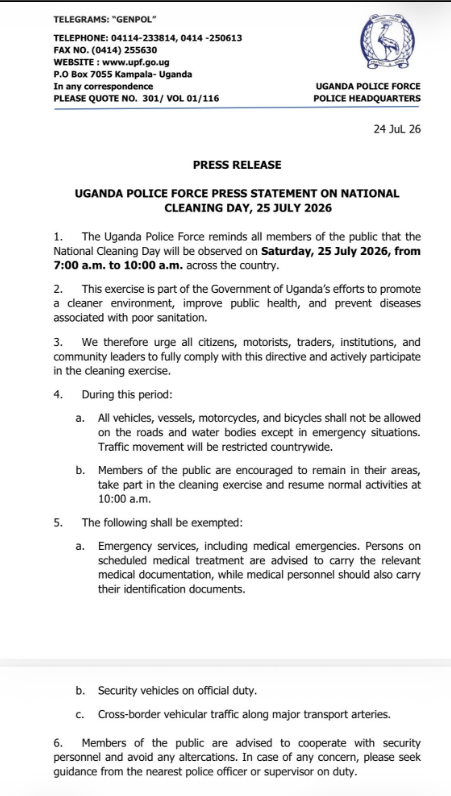
According to a police press statement issued on 24 July, movement of vehicles, motorcycles and bicycles will be restricted between 7:00am and 10:00am, with only emergency services, security vehicles on official duty and cross-border traffic along major transport corridors exempt from the directive.
The announcement follows the government’s declaration that the last Saturday of every month will be observed as a National Cleaning Day, during which citizens are expected to participate in organised community clean-up exercises.
In the statement, Uganda Police said the restrictions are intended to facilitate public participation in the three-hour cleaning exercise.
“All vehicles, vessels, motorcycles, and bicycles shall not be allowed on the roads and water bodies except in emergency situations. Traffic movement will be restricted countrywide,” the statement said.
Police urged motorists, traders, institutions, community leaders and the general public to remain in their respective areas and actively participate in cleaning activities before resuming normal business at 10:00am.
Authorities said the exercise forms part of the government’s broader efforts to promote environmental cleanliness, improve public health and prevent diseases associated with poor sanitation.
Police said several categories of people and vehicles will be allowed to move during the exercise and they include emergency medical services, patients travelling for scheduled medical treatment, provided they carry supporting medical documentation, medical personnel carrying official identification, security vehicles on official duty and cross-border commercial and passenger traffic using major transport corridors.
Police advised members of the public to cooperate with security personnel and seek guidance from officers on duty should any concerns arise during the exercise.
The traffic restrictions are part of the implementation of Uganda’s newly introduced National Cleaning Day, announced earlier this week by Prime Minister Robinah Nabbanja.
Government says the initiative is designed to address poor sanitation, which officials estimate contributes to nearly 75% of diseases reported across the country, including malaria, diarrhoea and typhoid.
The programme was approved by Cabinet in August 2025 and is anchored in Article 39 of Uganda’s Constitution, which guarantees every citizen the right to a clean and healthy environment while imposing a duty to protect it.
During the three-hour exercise, residents are expected to clean roads, drainage channels, markets, schools, health facilities, places of worship and other public spaces.
Among those questioning the restrictions was Ibrahim Ssemujju Nganda, using a parody account on X, who argued that a complete halt in movement could unnecessarily inconvenience citizens with urgent commitments.
In a post, the account claimed the restrictions could prevent travellers from reaching scheduled flights and suggested that those participating in the cleaning exercise should be allowed to do so without interrupting the normal activities of others.
The comments reflect broader concerns expressed by some members of the public regarding the practical implementation of the directive, particularly for travellers, businesses and workers with time-sensitive obligations.
Government officials have defended the restrictions, saying they are necessary to ensure meaningful nationwide participation and that the exercise lasts only three hours.
The announcement has prompted debate over how the restrictions will be enforced and whether there is sufficient legal authority to prohibit movement nationwide for a community sanitation exercise.
Deputy Inspector General of Police James Ochaya has previously said the Uganda Police Force is prepared to enforce the directive, drawing on operational experience gained during the enforcement of public health measures introduced during the Covid-19 pandemic.
Police have not announced specific penalties for individuals who fail to participate or violate the movement restrictions, but authorities have indicated that officers will be deployed across the country to ensure compliance.
Public health experts have welcomed efforts to improve sanitation, noting that poor waste management contributes significantly to outbreaks of communicable diseases and environmental pollution.
However, some legal analysts and members of the business community have questioned whether blanket movement restrictions could create unnecessary disruptions, particularly for travellers, shift workers and businesses that depend on uninterrupted operations.
The debate highlights the challenge of balancing public health objectives with the practical realities of daily life, especially as Uganda implements one of its most ambitious community-based sanitation campaigns in recent years.
The first mandatory National Cleaning Day will take place on Saturday, 25 July, from 7:00am to 10:00am, after which the programme will become a recurring event on the last Saturday of every month.
Government officials say the success of the initiative will depend on widespread public participation, cooperation with local authorities and sustained investment in sanitation infrastructure and waste management.
As Uganda embarks on the nationwide campaign under the theme “A Clean Uganda is Everybody’s Business,” the coming months are expected to test both public support for the programme and the government’s ability to implement it effectively while addressing concerns over its impact on everyday life.